
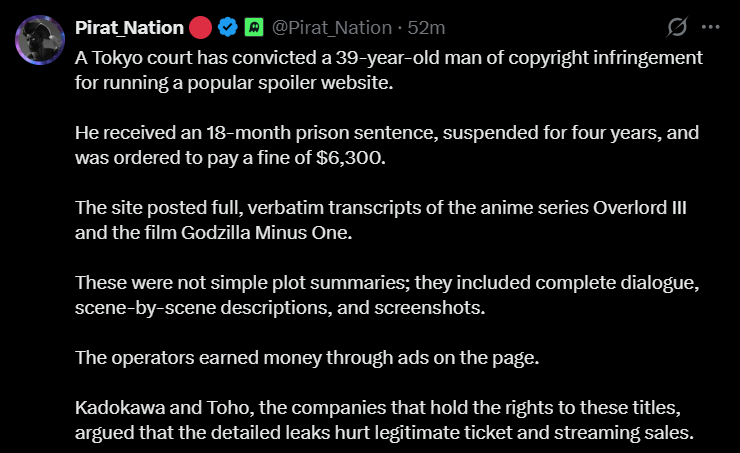
On April 16, 2026, the Tokyo District Court handed down a landmark guilty verdict against "Wataru Takeuchi," a 39-year-old Japanese man who served as the head of a spoiler website operating company. The court convicted Takeuchi of copyright infringement under "Japan's Copyright Act" for publishing extensive, unauthorized text-based summaries of two major copyrighted properties: "Godzilla Minus One" (which is owned by Toho Co., Ltd.) and "Overlord III" (which is owned by Kadokawa Corporation).
These were transcripts that included every character's name, every line of dialogue, every scene development, and hundreds of screenshots, all published without the rights holders' permission and all monetized through online advertising revenue.
The Tokyo District Court ruled that this level of detailed reproduction retained the "essential characteristics" of the original works, thereby qualifying as an unauthorized "adaptation," which is a classification that requires explicit permission from the original copyright holder under Japanese law.
Takeuchi was then sentenced to one year and six months in prison, suspended for four years, and ordered to pay a fine of 1 million yen (approximately US$6,300). This case was brought to court with strong backing from the "Content Overseas Distribution Association" (CODA), "Toho," and "Kadokawa," all of whom argued that verbatim online transcripts directly harm legitimate ticket and streaming sales.
This ruling effectively shows that reproducing copyrighted content in text form for ad revenue, even without video or audio piracy, is a straightforward criminal offense under Japanese copyright law. The Tokyo District Court established a critically important legal standard in this case. A text-only reproduction of a film or anime (if it captures the "essential characteristics" of the original) will qualify as an unauthorized derivative work or "adaptation" under Japan's Copyright Act.
"The conduct deprived copyright holders of legitimate opportunities to receive compensation and could undermine revenue models as well as the development of culture."
— Tokyo District Court, Presiding Judge's Ruling, April 16, 2026
According to CODA and the prosecution, the Godzilla Minus One article alone exceeded 3,000 characters, narrating the entire film from beginning to end in exact detail. The Overlord III entries included transcribed dialogue, character actions, plot twists, and scene-by-scene breakdowns of "isekai" anime series. Even screenshots from the original works were also embedded without licensing.
This site received huge traffic as readers could understand the full story of a movie without purchasing a ticket or subscribing to a streaming service. In return, the company earned revenue through ad placements on every page.
Takeuchi Pleaded Not Guilty:
Wataru Takeuchi entered a not guilty plea and mounted a legal defense that tried to draw a clear distinction between a text article and the full audiovisual experience of a movie.
"A text-only article was not enough to depict the visuals and audio that could only be presented through the full movie."
— Defense argument, as reported by Anime News Network
His legal team argued that a text-only summary (no matter how detailed) simply cannot replicate the visuals, sound design, musical score, or cinematography of a film. According to the defense, a written transcript lacks the sensory richness that makes a movie or anime unique, and therefore could not be considered a true substitute for the copyrighted work.
The court, however, rejected this argument entirely, ruling that the essential narrative and informational content was so thoroughly reproduced that readers gained the full story without needing to access the original work.
This Was Happened Before:
In a related case, a 46-year-old "co-defendant" who specifically wrote the Godzilla Minus One article on the same website had been convicted separately in July 2025. That defendant claimed that he had not recorded or copied the film, but rather had memorized the entire movie and then written the transcript from memory. The court still found him guilty and fined him 500,000 yen (approximately US$3,100).
Questions For You:
- What are your thoughts on this case?
- Is there a difference between a "review" and a "text-based spoiler"?
- Have you ever read a detailed summary and decided not to watch the movie because of it?
Let me know in the comments, where you can also provide the latest news so I can make a breakdown of it.