
Warner Bros. Discovery has scheduled a March 20, 2026 shareholder meeting to vote on a proposed $83 billion deal with Netflix. The board has publicly recommended that the shareholders vote for the deal. If this gets approved, the transaction would combine Netflix's global streaming engine with Warner Bros. Discovery's deep library of film, premium television, and news assets, which includes Warner Bros., HBO, DC Studios, and CNN. The board's endorsement suggests it believes the Netflix transaction delivers superior long-term shareholder value compared to competing bids.
However, the vote is critical: without majority shareholder approval, the deal cannot proceed. Meanwhile, Paramount Skydance also continues to pursue the company (Warner Bros) by often rephrasing its hostile bids. Even after multiple private proposals were officially rejected by the WBD board, Paramount Skydance again launched a hostile $108.4 billion all-cash bid ($30 per share) directly to WBD shareholders in December 2025.
Speaking of Shareholder Voting System, the shareholder approval is typically required under corporate governance rules. First, The company sets a date determining which investors are eligible to vote. Then, the shareholders receive detailed documents outlining deal terms, valuation metrics, risks, and board recommendations.
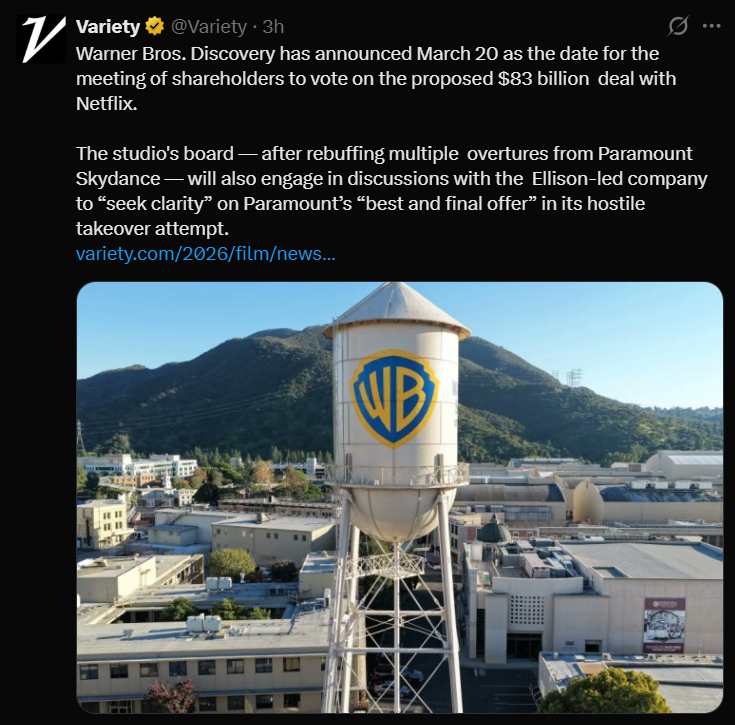
Looking through Voting methods, its clear that the investors can vote in person at the meeting, electronically, or via proxy (authorizing someone else to vote on their behalf). Most large mergers require a majority of outstanding shares to approve the transaction.
For Warner Bros. Discovery, shareholders will evaluate - the cash or stock consideration, regulatory risk, expected synergies, debt implications and as well as the long-term competitive positioning in the global streaming market.
Institutional investors (such as pension funds and asset managers) — often hold the significant voting power. Their decisions can hinge on advisory firm recommendations (for e.g., ISS or Glass Lewis) and on whether the board has fulfilled its fiduciary duty to secure the best available offer.
By seeing this strict voting system, we can clearly understand that if the vote fails, the Netflix's deal could collapse or be renegotiated. However, if approved, the deal would still require regulatory clearance before closing. The Netflix proposal is considered a "friendly" merger because it is supported by Warner Bros. Discovery's board.
However, Paramount's approach has been more aggressive recently. Paramount Skydance has repeatedly submitted bids despite board resistance, a strategy often described as a "hostile takeover attempt". Even after initial rejections, Paramount has sought "clarity" discussions and positioned itself as ready to present a "best and final offer."
Even after seeing the struggle of Paramount, many major outlets such as Variety, The Hollywood Reporter, and Bloomberg suggests that Netflix currently holds the structural advantage due to board support. Friendly deals historically have always higher probability of success than hostile bids.
The proposed merger is being positioned as one of the largest deals in modern media history, with implications for Hollywood consolidation, global content licensing, theatrical distribution, and the future of premium streaming. Anyways what do you guys think about the conclusion might be of this battle of Netflix and Paramount to acquire Warner Bros which has been ongoing for few months? Let us know all your answers in the comments, where you can also provide the latest news so I can make a breakdown of it.