
Jeff Bezos who is the founder of Amazon and the visionary behind Amazon Web Services (AWS) — believes that owning powerful local computers may become less common over time. According to his logic, computing power, like electricity, is often most efficient when shared through centralized infrastructure instead of being individually owned. Just as individuals no longer run their own power plants for homes, Bezos envisions a future where regular users rent processing power from cloud platforms rather than buying high-end computers — including gaming PCs, workstations, or heavy processing rigs.
The trend he highlights points toward the subscription-based compute services, thin clients, and cloud gaming becoming mainstream as AI and data-intensive workloads push the demand for scalable computing resources beyond what traditional PCs can economically deliver. Bezos has been articulating his views on cloud computing for years, "Everyone has their own data center today, and that’s not going to last," he said. He said this to highlight how companies currently build and run so-called "private data centers", which he compares to the old factories generating their own electricity before modern power grids existed.
He argues that this will shift toward shared cloud platforms like AWS. "You're going to buy compute off the grid — that’s AWS," Bezos said. This is a direct analogy Bezos uses that computing power will be a utility you tap into, much like electricity. He also imagines massive gigawatt-class data centers built in space to support the rising computational and energy demands of AI, cloud computing, and other future technologies, pointing to a long-term evolution of how computing is provisioned globally.
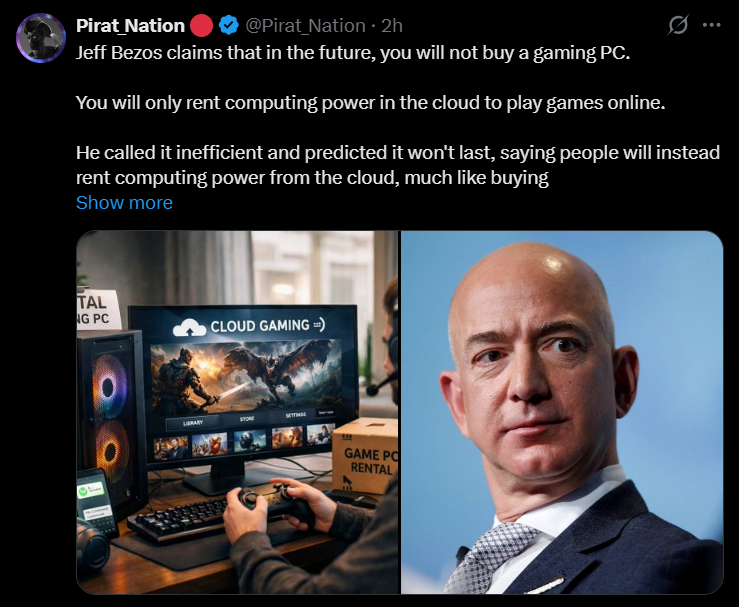
This vision of Bezos could happen, but only under certain conditions and not instantly. We know that cloud computing already dominates major parts of the internet as AWS, Azure, and Google Cloud host countless services you use every day. Even cloud gaming services like Xbox Cloud Gaming, Nvidia GeForce Now and Amazon Luna exist today. AI workloads push demand beyond consumer hardware limits as the training and inference tasks require massive compute that local PCs can't economically serve.
However, his prediction relies on several assumptions that might slow or limit adoption. The first one is obvious: cloud gaming and rented compute are limited by network speed. The second is that there's still "human preferences" today as enthusiasts often choose local PCs for performance, ownership, modding, and offline control. The last one is that cloud subscriptions must remain cheaper and accessible compared to buying hardware.
In short, Bezos' logic could play out for many users, especially casual gamers, remote workers, and even enterprise customers, but it definitely doesn't guarantee a world where nobody owns hardware at all. Anyway, what are your opinions related to this Jeff Bezos' logic? Let us know all your thoughts in the comments where you can also provide latest news so I can make a breakdown of it.