
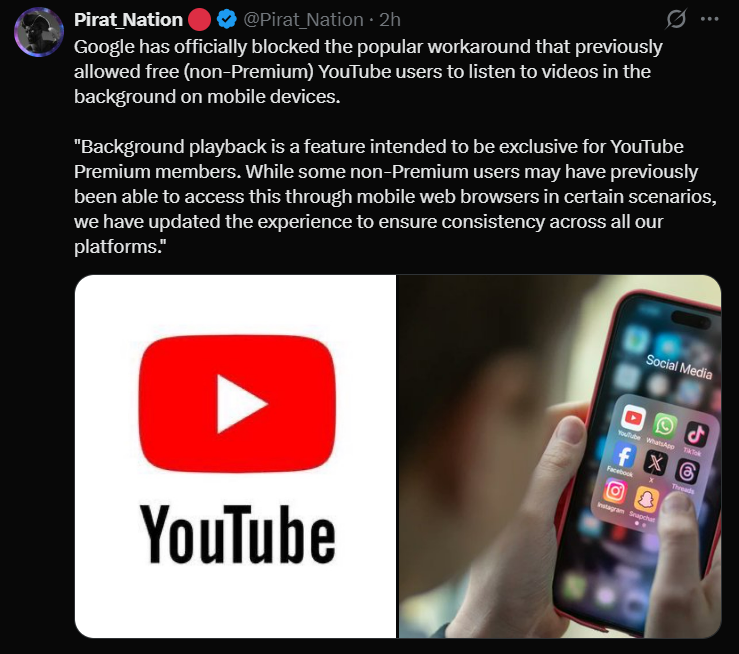
Google has now officially tightened the restrictions on background playback on YouTube, effectively blocking a popular loophole that allowed non-paying users to continue listening to videos after locking their phones or switching apps. Many of us know that background playback has long been marketed as a core benefit of YouTube Premium, alongside ad-free viewing and offline downloads. However, some free users previously accessed this feature through mobile web browsers in specific scenarios.
Now, platform updates have been rolled out and YouTube has ensured that background playback remains exclusive to Premium subscribers. If you attempt to play a video from a mobile browser and then lock your device, the audio now stops. This change is part of YouTube’s broader strategy to protect subscription-based features and maintain consistency across platforms.
Speaking of working of this loophole, users first opened YouTube in mobile browsers such as Google Chrome or Safari, then they switched the browser to "Desktop Site" mode. After doing that, a video was played from the web version instead of the YouTube app. So, when the phone was locked, playback would pause, but users could press "Play" again from the lock screen's media controls, because of which the audio would resume and continue running in the background.
Because this method relied on how browsers handled media sessions rather than an official "YouTube permission", it directly bypassed the platform's intended restrictions. Over time, the trick spread across social media under trending searches like "YouTube background trick 2026" or "Free YouTube Premium hack."
Throughout late 2024 and into 2025, YouTube began refining how background media sessions were handled on mobile browsers. The company then updated its web player behavior so that the background playback would automatically stop when the app was minimized or the device was locked (even in desktop mode).
Later, in official communication, YouTube clarified that:
"Background playback is a feature intended for Premium members, and the experience has been updated to ensure consistency across platforms." Reports of the workaround no longer functioning increased globally as updates rolled out server-side, which means the users didn't need to update an app — the change occurred on YouTube's end.
Many people think it was just a minor loophole, but from a business perspective, it was significant. This is because, background playback is one of the main reasons people subscribe to YouTube Premium, especially users who treat YouTube like a music streaming service competing with Spotify or Apple Music. Google fixed this with the aim of subscription revenue protection and maintaining platform consistency.
YouTube has been tightening its rules in several areas. In 2023–2024, YouTube started aggressively limiting users who used ad-blockers. Platforms like Netflix started stopping people from sharing passwords outside their household, because many users were watching without paying. YouTube has also improved monetization for creators by expanding premium revenue sharing.
YouTube has been tightening its rules in several areas. In 2023–2024, YouTube started aggressively limiting users who used ad-blockers. Platforms like Netflix started stopping people from sharing passwords outside their household, because many users were watching without paying. YouTube has also improved monetization for creators by expanding premium revenue sharing.
In many regions, YouTube has already positioned Premium as a bundled entertainment product for combining ad-free videos, YouTube Music, and offline access. Removing loopholes strengthens that bundle. Anyways, what do you guys think of this loophole? Have you tried that once? Let us know all your answers in the comments, where you can also provide the latest news so I can make a breakdown of it.