
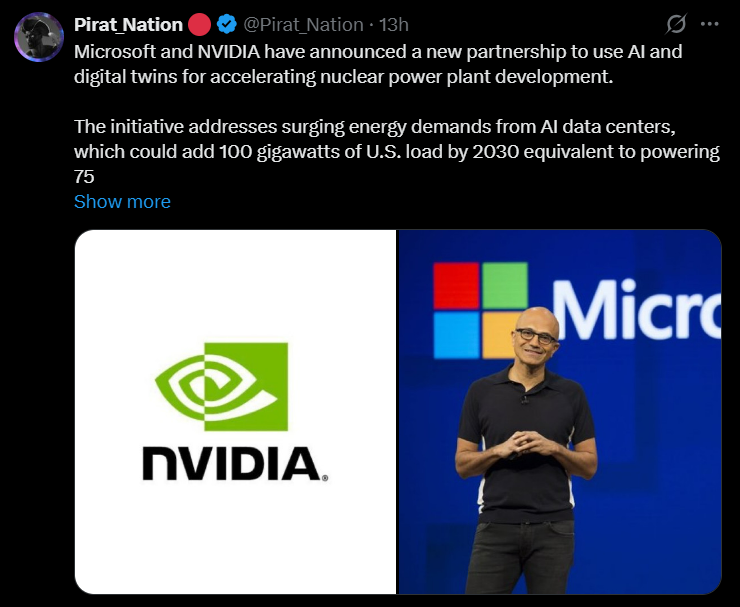
On March 24, 2026, at the "CERAWeek 2026" energy conference in Houston, Texas, Microsoft and NVIDIA officially announced a landmark joint initiative called "AI for Nuclear," which is a sweeping collaboration designed to radically cut the time, cost, and complexity of building nuclear power plants using artificial intelligence. Microsoft President "Brad Smith" revealed the program on stage, stating it would accelerate the construction of new reactors by shifting the industry away from one-off, highly customized engineering toward repeatable, reference-based nuclear design.
According to reports, this is not a future concept. The tools are already deployed, already saving money, and already producing results, which is making this one of the most consequential clean energy announcements of 2026.
The Reason?
Energy demand for AI data centers is skyrocketing. According to the "International Energy Agency" (IEA), data centers could add as much as 100 gigawatts of electrical load to the U.S. grid by 2030, which is equivalent to powering 75 million homes. Renewable sources like solar and wind cannot reliably provide the 24/7, always-on power that massive AI computing clusters require.
So, nuclear energy, being carbon-free and continuous, has emerged as the only scalable answer. However, there's a critical problem and that is, a nuclear plant typically takes five to ten years to build, while AI's power demands are growing now. That is precisely the gap Microsoft and NVIDIA are racing to close.
How The System Actually Works?
The technology stack Microsoft and NVIDIA have assembled is not a single product but a full AI-powered nuclear lifecycle platform, spanning four distinct phases of reactor development. Engineers use NVIDIA Omniverse-powered digital twins, which are virtual, real-time 3D replicas of the physical plant, to test design changes without touching a single physical component. This replaces years of iterative physical prototyping with hours of virtual simulation, using NVIDIA's PhysicsNeMo, Isaac Sim, and Earth-2 platforms.
Nuclear permitting is historically one of the most expensive and time-consuming stages, requiring tens of thousands of pages of documentation to be reviewed by regulators. Microsoft's "Generative AI for Permitting Solution Accelerator" automates document drafting, performs gap analysis, and aligns new applications with historical approvals. Aalo Atomics, a Texas startup building modular reactors for data centers, cut its permitting workload by 92% using this tool, saving an estimated $80 million per year.
The Microsoft-NVIDIA system adds a 4D time-scheduling layer and a 5D cost-tracking layer, which effectively let developers virtually construct the entire nuclear plant before any ground is broken. Once a plant is running, AI-powered sensors and operational digital twins continuously monitor for anomalies that flag irregular readings before they escalate into safety incidents or grid instability events. The "IAEA" describes this capability as critical for safe nuclear expansion globally.
Anyways, what are your thoughts on using AI to build nuclear plants? What are the advantages and disadvantages you think it could bring? Let me know all your answers in the comments, where you can also provide the latest news so I can make a breakdown of it.