
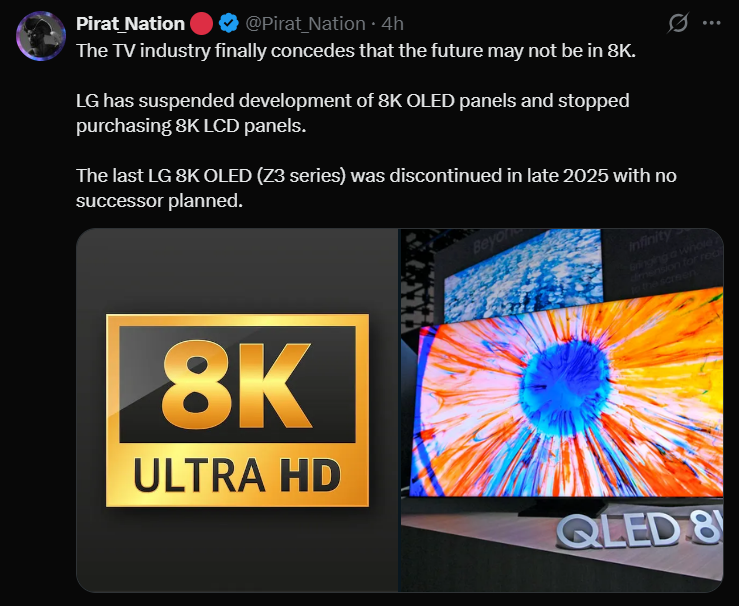
In early 2026, the global television industry finally admitted what many tech reviewers and consumers suspected for years. That is, 8K Ultra HD TVs are not becoming the mainstream future of home entertainment. Major companies are now abandoning 8K development altogether. Even LG, the last major manufacturer was actively producing 8K OLED TVs, has stopped development of new 8K OLED panels and is no longer buying 8K LCD panels for future sets.
Even its final 8K OLED model, the Z3 series, was quietly discontinued at the end of 2025 with no successor planned. Now the industry is focusing on technologies that matter more to consumers, such as advanced 4K OLED, Mini-LED, HDR, gaming features, and AI upscaling. Major companies have realized that there are no huge differences between 8K and 4K TVs.
List of Famous TV Brands That Have Stopped or Reduced Focus on 8K
- LG Electronics & LG Display: Officially paused 8K OLED panel development and will no longer introduce new 8K models in 2026.
- Sony: Discontinued its 8K TV line (e.g., Z9K series) and is not expected to release new 8K TVs soon.
- TCL: Has not included 8K TVs in recent lineups (e.g., 2024), citing weak consumer demand and prioritizing premium 4K models instead.
- Hisense and other regional brands: Less emphasis or older 8K offerings with no active new 8K development.
Speaking of exact reasons, Streaming platforms like Netflix, Disney+, Prime, and most broadcasting still deliver content mostly at 4K or lower. There is virtually no mainstream 8K native content available yet. Another reason is that 8K TVs cost a lot more to manufacture and sell, which kept consumer interest very low, with 8K models representing only about 0.1% of TV sales worldwide.
Unless you're sitting very close to a giant screen (e.g., >85 inches at close viewing distance), most people cannot even tell the difference between 4K and 8K. Also, Streaming real 8K requires huge data bandwidth and upon that, many TVs struggle with true compressed 8K input over HDMI 2.1, making compatibility and performance less reliable.
According to market research, global 8K display shipments reached around 5.6 million units, up from roughly 350,000 in 2021. However, 4K and Full HD TVs still account for about 85 % of all TV units sold worldwide, meaning most consumers prefer standard and 4K models over 8K. In financial terms, the 8K TV market was valued at about USD 9.24 billion in 2025 and is forecast to nearly double by 2030, but this growth is from a relatively small base and is far overshadowed by the overall TV market size — which was estimated at tens of billions of dollars in 2024 when combining 4K and 8K segments.
It is clear that 8K TVs are no longer the main future of television. Only Samsung still supports 8K at scale, and even that support may taper if demand stays weak. If you're planning to buy a new TV in the next 1–3 years, choose a high-end 4K set (OLED, QLED, or Mini-LED) for better value and best real-world performance. If you already have a recent 4K TV, then stick with it.
Buy an 8K TV only if you have specific needs (like professional production or wall-scale screens), but don’t expect much 8K content yet. Anyways, what are your thoughts on 4K and 8K TVs? How was your experience using either of these? Let us know all your answers in the comments where you can also provide the latest news so I can make a breakdown of it.