
Lenovo has raised the price of its flagship Legion Go 2 handheld gaming PC to $2,849.99 on its official store for the Ryzen Z2 Extreme / 2TB SSD configuration. It's a rise of a whopping 93% in under six months, when that same model retailed for approximately $1,480. This marks the latest and most dramatic step in a series of aggressive price increases that have hit the device since its October 2025 launch.
In fewer than six months, the price has nearly doubled. The base Ryzen Z2 Extreme model with 1TB storage, which launched at $1,349.99, has also been pushed to $1,999.99 at major retailers like Best Buy, which is a 48% increase. Even the entry-level Ryzen Z2 variant climbed from $1,099.99 to $1,499.99, is a 36% rise as well.
Reason?
The main reason behind these increases is obviously global DRAM shortage again, which is widely being called the "RAMpocalypse" or "RAMageddon." As AI infrastructure companies like OpenAI, Google, Microsoft, and Meta have signed open-ended, premium-price contracts with the world's three dominant memory manufacturers - Samsung, SK Hynix, and Micron - the supply of conventional DRAM for consumer electronics has been severely squeezed.
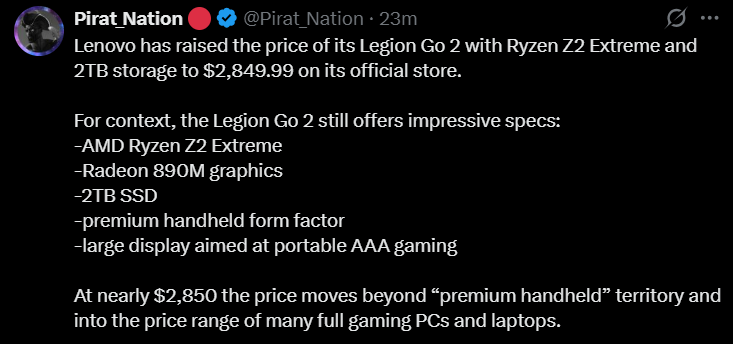
According to "TrendForce," DRAM contract prices climbed approximately 90–95% in just the first quarter of 2026. The IDC has noted that memory, which once represented 15–18% of a PC's bill of materials, now accounts for closer to 35%. So, for a device like the Legion Go 2, which ships with 32GB of high-speed LPDDR5X RAM in its flagship configuration, the impact has been catastrophic to its pricing.
"I keep telling everybody that if you want a device, you buy it now."
— Avril Wu, Senior Research VP, TrendForce (via NPR, December 2025)
Lenovo has made no official public statement explaining the Legion Go 2 price hike. The increases were first spotted by Insider Gaming, observing changes at Best Buy. However, Lenovo CFO "Winston Cheng" described this cost surge in component as "unprecedented," disclosing the company's memory inventories were being built up well above normal levels in anticipation of further price increases.

The ASUS "ROG Xbox Ally X," which is powered by the same AMD Ryzen Z2 Extreme APU, has held firm at $999.99, which is less than half the current "Legion Go 2" price, with ASUS stating there is "no price increase on the horizon." Tom's Hardware noted that the Legion Go 2 now costs more than AMD's Strix Halo-based devices, which offer significantly stronger performance.
The "OneXPlayer Apex" with a Ryzen AI Max+ 395 and 64GB RAM can be pre-ordered for $2,799, which is still somehow cheaper than Lenovo's 2TB Legion Go 2. Analysts and reviewers have concluded that Lenovo's pricing appears to go beyond simply compensating for the memory crisis; the gap with comparably-specced rivals is too wide to be explained by component costs alone.
Lenovo Legion Go 2:
The Lenovo Legion Go 2 is a premium Windows handheld gaming PC launched at IFA in September 2025 and officially released on October 31, 2025. It is Lenovo's second-generation successor to the original Legion Go, which is positioned as a direct competitor to the "ASUS ROG Xbox Ally X" and "Valve's Steam Deck OLED." It launched with Windows 11 as the primary operating system, with a SteamOS version planned for June 2026.
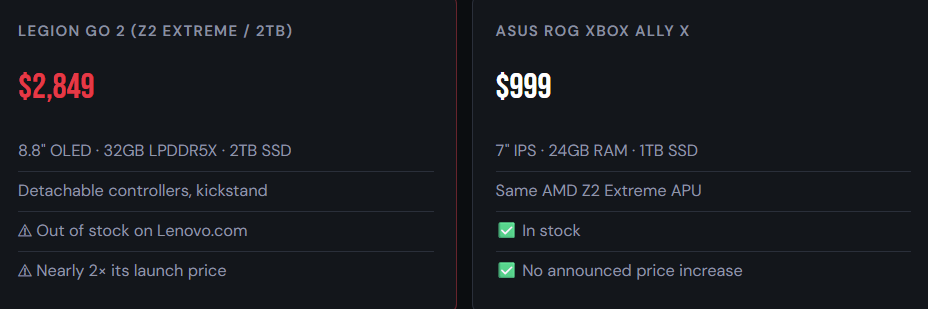
The device is built around AMD's Ryzen Z2 and Ryzen Z2 Extreme APUs, which are the same silicon found in the Xbox Ally X, but differentiates itself through a larger 8.8-inch OLED display with VRR, a detachable joystick system that is similar to the Nintendo Switch, a built-in mouse trackpad, a rear kickstand, 32GB of LPDDR5X RAM in its flagship variants, and up to a 2TB NVMe SSD.
Questions:
- What are your thoughts on the recent price change of Legion Go 2 and other its other models?
- What's your experience using these handheld gaming devices?
- Which other handheld products do you prefer in this situation?
Let me know in the comments, where you can also provide the latest news so I can make a breakdown of it.