
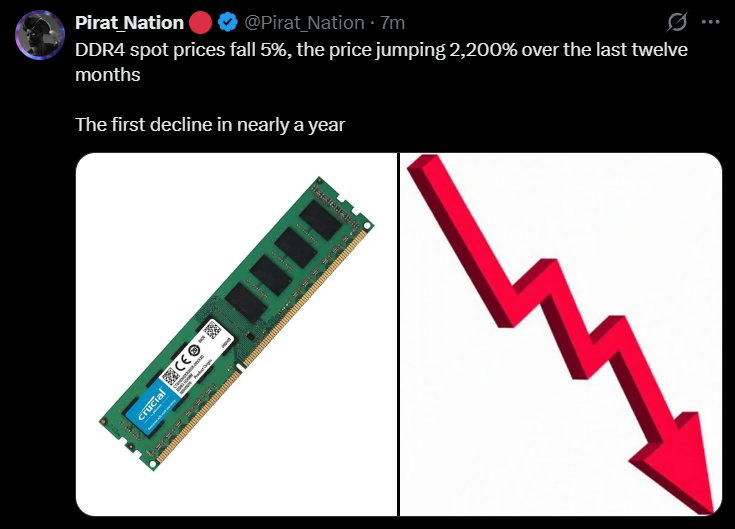
DDR4 spot prices have recorded their first monthly decline in nearly a year, falling roughly 5% to approximately $74.10 for a 16GB chip, which is according to data reported by "DigiTimes" and corroborated by "Tom's Hardware." This is the first monthly drop since February 2025. Just twelve months ago, that same 16GB DDR4 chip was trading at around $3.20, meaning prices exploded by a staggering 2,200% in a single year, which is an increase that dwarfed even gold as an asset class.
Alongside DDR4, 16GB DDR5 modules also eased by a comparable percentage to around $37.20, with the sharpest corrections showing up in Chinese channel listings and on major e-commerce platforms. DDR5 had similarly surged from $5.30 to over $37 over the same twelve-month window, which is a roughly 600% increase.
The DRAM spot price decline is most pronounced in China's channel market, where 32GB DDR5 kits have reportedly dropped by as much as 27% in a single month, and 8GB and 16GB DDR4 modules posted weekly declines of approximately 25%, according to China Flash Market data cited by "DigiTimes."
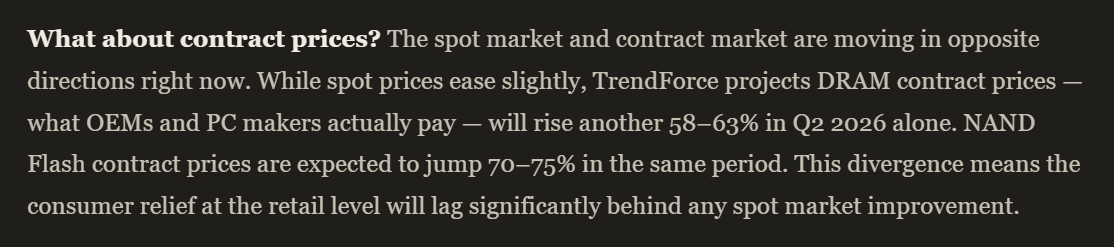
However, this is a spot market correction, not a retail or contract market relief. TrendForce's latest survey projects another 58–63% quarter-on-quarter rise in conventional DRAM contract prices in Q2 2026, following record Q1 increases of 90–95%. Most importantly, none of this correction has yet reached the contract market, where PC manufacturers (OEMs) and enterprise system builders actually source their memory.
Major suppliers, including Samsung, SK Hynix, and Micron have not eased the pricing, and customers continue signing long-term supply agreements at elevated rates. The three major DRAM manufacturers, alongside Chinese competitors CXMT and YMTC, remain firm on pricing. Spot sales represent only a small fraction of total memory shipments globally, which means this channel correction has a limited direct bearing on the hardware prices most consumers and businesses actually encounter.
How DDR4 Prices Collapsed?
The memory market entered 2023 with massive inventory gluts; DRAM suppliers were sitting on as many as 31 weeks of unsold stock. This oversupply crushed prices throughout 2022 and 2023, bringing DDR4 to cheap levels. A 16Gb DDR4 chip hit a trough of around $3.20 in early 2025, after declining for nearly two years.
"Today will always be the cheapest day"
— an industry insider describing DRAM market sentiment during Q2 2025 negotiations.
Reasons DDR4 Prices Exploded:
The AI industry's voracious appetite for high-bandwidth memory (HBM) forced semiconductor manufacturers, primarily Samsung, SK Hynix, and Micron, to radically reallocate the production capacity. Manufacturers redirected more than three times the wafer capacity to HBM chips compared to conventional DRAM, causing a severe supply squeeze for standard DDR4 and DDR5 products.
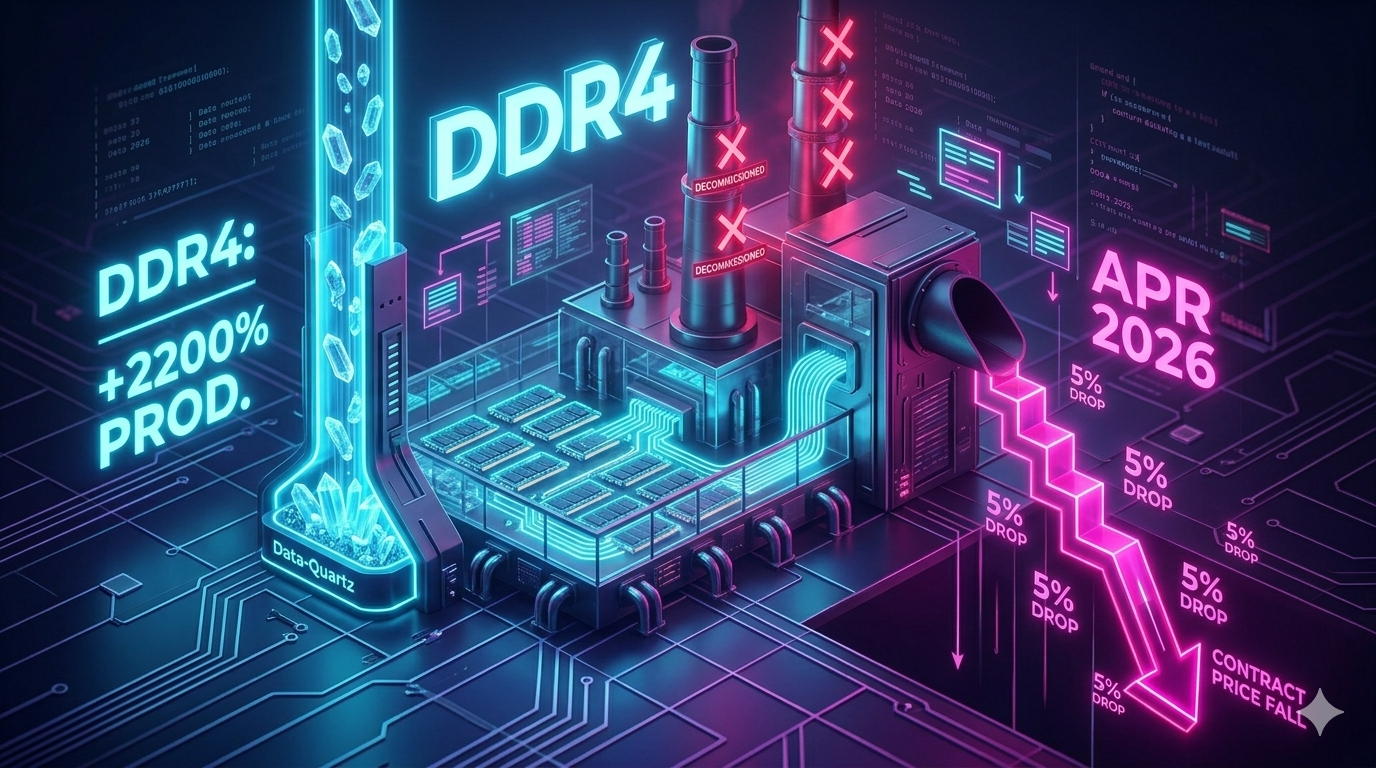
Both Samsung and Micron effectively halted most DDR4 output in 2025, compounding the supply crunch. Meanwhile, AI infrastructure spending by "hyperscalers," such as: Alphabet, Amazon, Meta, and Microsoft, collectively planning around $400 billion in AI capital expenditure, created a demand that no existing production line could satisfy.
As OEMs and distributors anticipated further price increases (and, in the US, front-ran potential chip tariffs), they over-ordered, often doubling or tripling their usual volumes, thus creating an artificial scarcity feedback loop. The April 2024 Taiwan earthquake and a Samsung production strike both tightened supply further.
Prices Started To Fall For Now:
With 32GB DDR5 kits reaching $400–$500 at retail and DDR4 kits tripling in cost, a growing segment of consumers have delayed or cancelled PC builds entirely and motherboard sales reportedly dropped 40–50% year-over-year. This demand reduction eventually filters into spot market pricing.
Chinese channel inventory may be clearing faster than expected, leading to localized oversupply in that market segment. There is also a speculation, which is reported by TechRadar that "OpenAI" may have scaled back some of its originally projected memory-intensive AI training ambitions, slightly easing the pressure on AI-driven DRAM demand. TrendForce's weekly data shows selling pressure remains controlled but persistent, with DDR4 1Gx8 3200MT/s chips easing from $33.96 to $33.56 in the most recent week.
For the Korean government's part, regulators have pledged to take "strict measures" against what they describe as unfair pricing practices in the PC and RAM market, and have reportedly moved to repurpose decommissioned government PCs to ease retail supply pressure.
- What are your thoughts on this recent price fall?
- Do you think the price will go up even more in future?
Let me know in the comments, where you can also provide the latest news so I can make a breakdown of it.